At IIT Bombay, ITS India Forum takes road safety from discussion to deployment
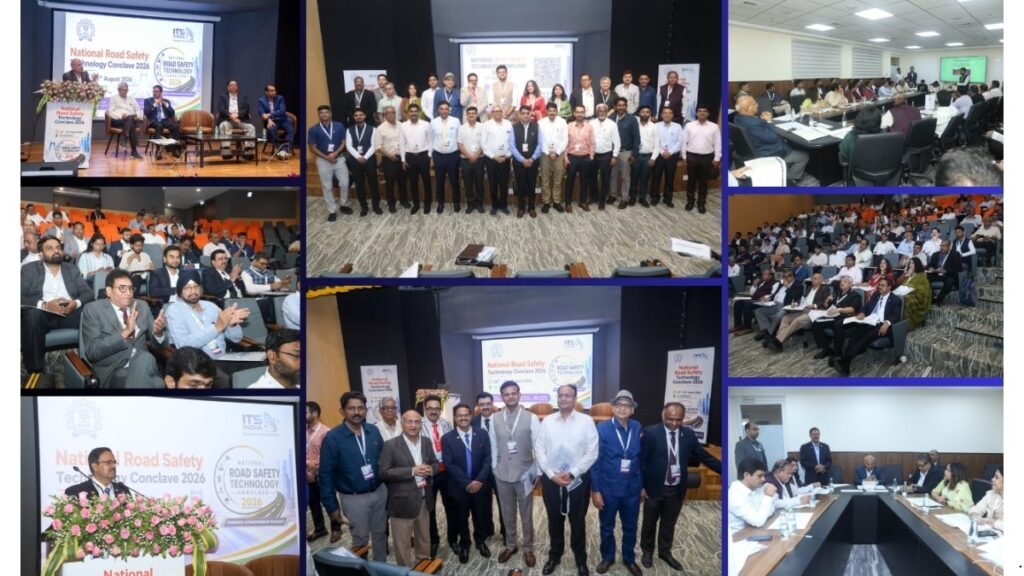
NRSTC 2026, organised by ITS India Forum in collaboration with IIT Bombay
New Delhi [India], August 29: The technology is ready to deploy. More than 28 indigenous technologies were placed before 250-plus delegates from the central ministries & 16 state governments, the IITs, industry, and domain experts gathered to act on road safety, not to discuss it. Chairman Justice Abhay Manohar Sapre and Member Shri Sanjay Bandyopadhyay of the Honorable Supreme Court committee on Road Safety attended the conclave for the entire 02 days.
MUMBAI, August 26
More than 28 road safety technologies were presented at IIT Bombay on 25-26 August 2026 to over 250 delegates from 16 State Governments comprising Directors General and Inspectors General of Police, Transport Commissioners, Joint and Deputy Commissioners, Inspectors General, Academics and seasoned industry practitioners at a conclave that concluded India’s obstacle to deploying them nationally is no longer a technical one.
NRSTC 2026, the National Road Safety Technology Conclave, held on August 25 and 26 and organized by ITS India Forum in collaboration with IIT Bombay, asked every developer the same five questions the problem addressed, the solution, the evidence, what they need from government/other stakeholders, and what they will commit to deploying if they get it.
The second day was set aside entirely for the fourth question, with developers, highway authorities, police officers and transport officials in a single room.
“Road accidents are avoidable: it is not the will of God,” said Justice Abhay Manohar Sapre, Chairman of the Supreme Court Committee on Road Safety (SCCoRS), underlining how seriously the Committee views its mandate to improve road safety.
“We need to trust these GenZ efforts and go beyond discussion on road safety and move to action on the ground”. These technologies are maturing, and their impact is already visible locally. What is needed now is to consolidate, bringing that momentum together into action at the India level,” said Akhilesh Srivastava, President, ITS India Forum.
“We did not want another meeting where road safety is discussed. We wanted one where it is acted upon,” said Archak Mittal, IIT Bombay. “Every presenter was asked to state exactly what they need from government and exactly what they will deploy in return. Those commitments are now on record.”
What was on show?
The technologies ranged from the vehicle technologies, low cost retrofit ADAS, to V2X, AI based advanced traffic management systems to capturing near misses, tracking potholes on real-time to tracking driver’s behaviour and their health hazards using AI with cost effective solutions to enhancing GOI accident reporting portal e-DAR using AI for adding missing details and ambulance prioritisation as well as tracking injured person health in ambulance using AI & scanner and connecting to hospital on the fly to save critical times to save lives.
Retrofit kits now add automatic braking and speed limiting to vehicles built without any driver assistance. Contactless radar can detect a driver’s cardiac or respiratory collapse at the wheel, without a camera in the cabin. One system triggers the brake light the moment a driver lifts off the accelerator, buying the vehicle behind a fraction of a second.
At the roadside, number plate recognition is being linked to live checks on insurance, fitness and pending challans, so that a violation produces a consequence rather than only a record.
At the junction, adaptive signal systems recalibrate themselves against live traffic, and video analytics count near-misses, the risky turns, and pedestrian conflicts that occur long before anyone is hurt.
Elsewhere, cloud-delivered speed limit data reaches a vehicle whether or not the sign on the road is legible; existing signals are coordinated to hold a green corridor for an ambulance; and a police officer can dictate a crash report in his own language and have it arrive structured and complete.
Several developers said their systems were calibrated specifically for Indian mixed traffic two-wheelers, auto-rickshaws, cyclists and pedestrians sharing the same carriageway and built to run on camera and signal infrastructure States have already paid for.
The same four asks
Across very different technologies, the requests to government converged.
The most common was to recognize their efforts and give somewhere to work: a nominated corridor, a bus depot, a set of high-risk junctions. Developers said pilots routinely stall for months over who has the authority to say yes. The majority were ready to do a pilot free of cost; they just needed support.
The second was access to data India has already built. VAHAN, e-challan, eDAR, iRAD, and the insurance database all exist, but no documented route exists for a deploying agency or its technology partner to plug into them. Without it, an innovator’s solution can’t scale, detected violations cannot be controlled, and a crash report cannot be uploaded without being typed in again.
The third concern was procurement language. Tenders are written around hardware, specifying a particular sensor make rather than the outcome being bought. Innovators are always at a disadvantage because similar technology can’t be matched, yet RFPs mandate similar specifications and exclude them before evaluation begins, despite their technologies performing better; as a result, they are exploited by old RFP players. Governments should modify outdated procurement rules to match the digital-age procurement process and should be the biggest buyers of these innovative technologies, like the USA and China.
The fourth was standards and spectrum: allocation for vehicle-to-vehicle communication, an agreed operating band for in-cabin sensing, common definitions for measuring near-misses, Sade Driving Scores (SDS) and rules on video retention and privacy. Without them, officials said, each city buys a system that cannot speak to the next city’s.
Where pilots die
Developers described a recurring pattern in which a demonstration succeeds and then goes nowhere.
No agreed threshold marks when a pilot becomes a program. Before-and-after evaluation, which would establish whether a technology worked, is rarely funded as part of the deployment.
Officials pointed to a related difficulty on their side. Crash data, the basis on which any of this should be judged, remains incomplete; fields go unfilled, events go unreported, and some causes are not recorded at all.
The blind spot
Participants also noted what the field is not addressing.
Two-wheeler riders account for the largest single share of India’s road deaths, and pedestrians for a substantial further share. The technologies presented were weighted heavily towards four-wheelers, commercial fleets and urban junctions.
Rural roads, where a large proportion of fatalities occur, drew the least attention of all.
Next
The conclave’s closing session was structured to produce a sequence rather than an endorsement of which decisions a State can take on its own, which need the Center, and which can be taken this year.
“The technology is no longer the question. Over these two days we saw that these systems work, and that the majority of them are built in India,” said Akhilesh Srivastava, President, ITS India Forum, while concluding. He elaborated that “deployment is a decision, not an invention”.
Organizers said they would compile and submit the shortlisted proposals and the specific asks attached to each to the Government of India, different Ministries, Noto Aayog, and the participating State governments.
If you object to the content of this press release, please notify us at [email protected]. We will respond and rectify the situation within 24 hours.