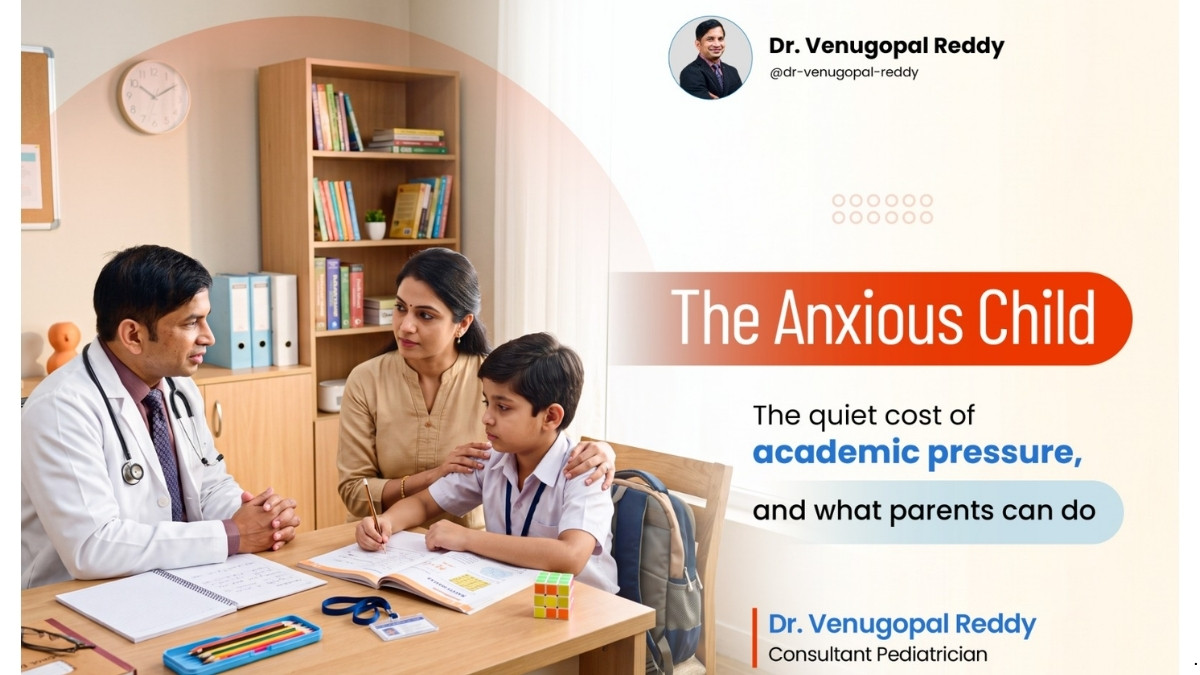
The Anxious Generation: Why More Indian Children Are Struggling, and What Parents Can Do

Bengaluru (Karnataka) [India], August 13: For a growing number of Indian children, the pressure to perform now begins early and weighs heavily. In a 2022 national survey conducted under the Education Ministry’s Manodarpan initiative, around 81 percent of school students said examinations and results were a source of anxiety. UNICEF’s 2024 assessment of child and adolescent mental health found that nearly one in four school-going children evaluated in educational settings showed signs of a psychiatric concern. And according to National Crime Records Bureau data, student suicides in India rose from roughly 8,400 in 2013 to nearly 13,900 in 2023.
Behind those numbers, pediatricians are noticing a quieter shift inside the clinic.
“Anxiety in children rarely announces itself.” observes Dr. Venugopal Reddy, Medical Director and Consultant Pediatrician at Ovum Woman and Child Specialty Hospital in Bangalore.
“A parent brings a child in for stomach aches, headaches, poor sleep, or a sudden loss of appetite. The tests come back normal. Very often, what we are actually seeing is anxiety wearing a physical disguise.” he adds.
The pressure now starts early
Academic anxiety no longer waits for the board-exam years. Competition now reaches into primary school, shaped by tuition schedules, ranking culture, and comparison that follows children home through their phones. For many, the sense of being measured is constant.
“We have quietly turned childhood into a race that starts in kindergarten.” Dr. Reddy says.
“By the time many children reach their teens, they have absorbed the idea that their worth is tied to a rank. That belief is exhausting to carry, and it rarely stays confined to the classroom.” he notes.
The signs parents miss
Part of the difficulty is that anxiety in children seldom looks the way adults expect. Rather than open worry, it often surfaces as irritability, avoidance, clinginess, disturbed sleep or appetite, unexplained physical complaints, a drop in grades, or a reluctance to go to school at all. The child who was once talkative may go quiet, and the confident one may start to fear small, familiar tasks.
“Parents often expect anxiety to look like sadness. In children it more often looks like anger, avoidance, or a stomach that hurts every morning before school.” Dr. Reddy explains.
What actually helps
The most powerful response, he argues, is usually the least technical. It begins with a parent who listens.
“Most parents do not need more information. They need to listen long enough to ask the right question. A child who feels heard at home carries a buffer that no coaching class can provide.” he says.
From there, the practical steps are steady rather than dramatic: protecting sleep and unstructured play, easing comparison, keeping expectations realistic, treating effort as seriously as marks, and modelling calm rather than panic. He also cautions parents about the compounding effect of social media, where comparison never switches off. Teachers and schools, he adds, are natural allies, and a quiet word with a class teacher often reveals patterns a parent never sees at home. When distress is persistent, he stresses, professional help matters and should carry no shame.
“Seeking help for a child’s mind should be as ordinary as seeing a doctor for a fever. The earlier we address anxiety, the easier it is to resolve, and the less likely it is to follow a child into adulthood.” Dr. Reddy notes.
The encouraging news, he says, is that childhood anxiety is highly treatable once it is recognised. The task for parents is not to remove every pressure a child will ever face, but to make sure a child never feels alone inside it.
Dr. Venugopal Reddy shares insights on child health, development, and parenting on LinkedIn: linkedin.com/in/dr-venugopal-reddy
If you object to the content of this press release, please notify us at [email protected]. We will respond and rectify the situation within 24 hours.